
Fire stopping and compartmentation · London
Fire stopping and compartmentation in Islington
Social landlords in Islington can use us to close out fire risk assessment actions on compartmentation and fire stopping.
We take on fire stopping and compartmentation works in Islington for the London Borough of Islington, housing associations and supported housing providers, managing every trade ourselves and working to the timescales in your order. The London Borough of Islington still owns about 25,303 council homes here, alongside housing association stock.
Islington at a glance
- Council
- London Borough of Islington
- Region
- London
- Council homes
- Council-owned, managed by the council
- Approx. council homes
- 25,303 (2020)
- Housing standard
- Decent Homes Standard (England)
- Damp and mould timescales
- Awaab's Law (since 27 Oct 2025)
- Population
- 248,115 (2020 estimate)
- Regional price factor
- 1.22 (VOA 2026)
Council housing status from Housing Revenue Account records (MHCLG and the 2012 HRA list, updated for later transfers) and council publications, checked October 2026. Population: ONS 2020 mid-year estimate.
Who owns the social homes in Islington?
The London Borough of Islington still owns council homes in Islington and manages them directly, funded through its Housing Revenue Account. The latest published figure we found is about 25,303 council homes (2020). Housing associations also own and manage social homes in the area, and we can work for both.
What do we cover in Islington?
- Compartmentation surveys of risers, ceiling voids and roof spaces
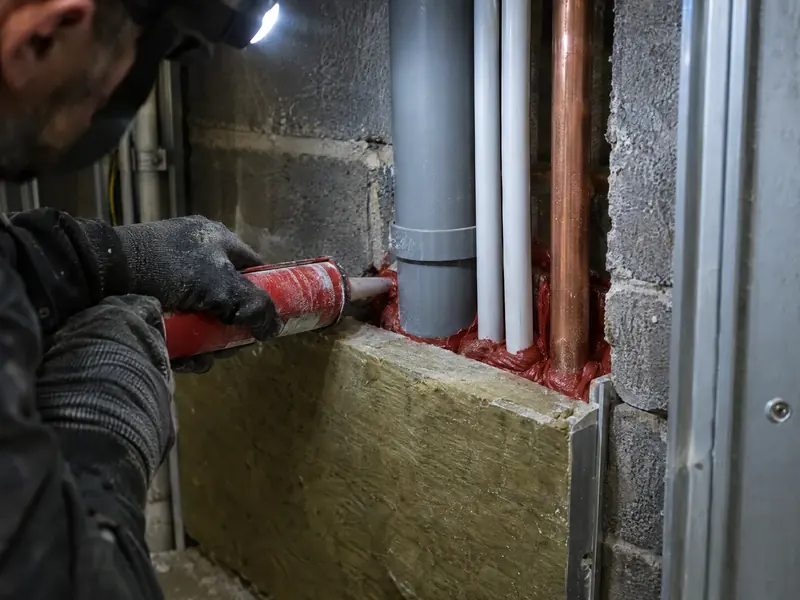
- Sealing service penetrations with tested systems
- Fire-rated boarding and ceiling repairs
- Fire dampers coordination with specialists
- Penetration logs with photographs and product references
How do we deliver it?
We match the system to the penetration: plastic pipes, metal pipes and cable bundles each need a different tested solution.
Which rules apply in Islington?
Under the Building Safety Act 2022, building work in higher-risk buildings (18 metres or 7 storeys and above, with at least two homes) needs Building Safety Regulator approval before it starts unless it is exempt; most repairs and like-for-like replacements are exempt, but heating systems, fuse boxes and glazing units are not. Approval can take up to eight weeks for existing buildings, so we build it into the programme.
Decent Homes Standard (England) · More about fire stopping and compartmentation works
What do fire stopping and compartmentation works cost in Islington?
We price fire stopping and compartmentation works in Islington after a survey rather than from a guide range, because the number and type of penetrations, access to risers and voids, and building height vary from block to block. Send us the details and we will arrange a visit.
Questions about fire stopping and compartmentation works in Islington
Does the London Borough of Islington still own council homes?
The London Borough of Islington still owns council homes in Islington and manages them directly, funded through its Housing Revenue Account. The latest published figure we found is about 25,303 council homes (2020). Housing associations also own and manage social homes in the area, and we can work for both.
Can you take on fire stopping and compartmentation works in Islington as a subcontractor?
Yes. Main contractors working for social landlords in Islington can engage us as a tier-2 subcontractor for fire stopping and compartmentation works, working under their systems and their client's specification.
Which housing standard applies in Islington?
Social homes in England must meet the Decent Homes Standard, enforced through the Regulator of Social Housing's Safety and Quality Standard. A reformed standard, confirmed in January 2026, must be met by 2035 at the latest.
Other works we carry out in Islington
- Smoke, heat and CO alarm installation
- Planned maintenance and Decent Homes works
- Cyclical and external decoration
- Void property works
- Fire door installation and remediation
- Loft and cavity wall insulation
- Aids and adaptations
- Heating upgrades and heat pumps
- Estate and external works
- Responsive repairs
- Roofing and rainwater goods
- Supported and sheltered housing refurbishment