
Aids and adaptations · West Midlands
Aids and adaptations in Birmingham
If you have a list of adaptations waiting in Birmingham, we can price them in the format your funding route requires and work through them.
We take on aids and adaptations in Birmingham for Birmingham City Council, housing associations and supported housing providers, managing every trade ourselves and working to the timescales in your order. Birmingham City Council still owns about 57,313 council homes here, alongside housing association stock.
Birmingham at a glance
- Council
- Birmingham City Council
- Region
- West Midlands
- Council homes
- Council-owned, managed by the council
- Approx. council homes
- 57,313 (2026)
- Housing standard
- Decent Homes Standard (England)
- Damp and mould timescales
- Awaab's Law (since 27 Oct 2025)
- Population
- 1,140,525 (2020 estimate)
- Regional price factor
- 0.97 (VOA 2026)
Council housing status from Housing Revenue Account records (MHCLG and the 2012 HRA list, updated for later transfers) and council publications, checked October 2026. Population: ONS 2020 mid-year estimate.
Who owns the social homes in Birmingham?
Birmingham City Council still owns council homes in Birmingham and manages them directly, funded through its Housing Revenue Account. The latest published figure we found is about 57,313 council homes (2026). Housing associations also own and manage social homes in the area, and we can work for both.
What do we cover in Birmingham?
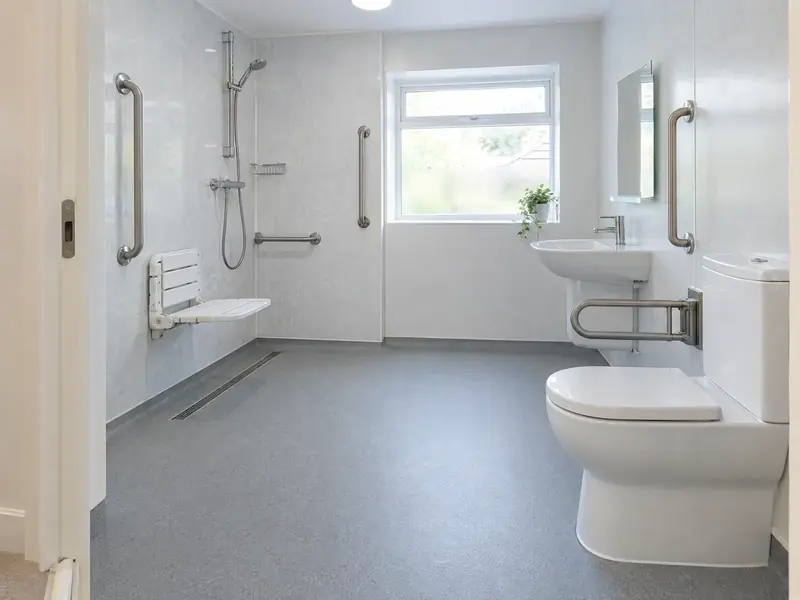
- Grab rails, stair rails and lever taps
- Level-access showers and wet rooms
- Stairlifts and through-floor lifts, coordinated with specialist suppliers
- Kitchen adaptations at accessible heights
- Ground-floor bedroom and shower room extensions
How do we deliver it?
Where possible, we hand over with the occupational therapist present, so any adjustment can be agreed on the spot.
Which rules apply in Birmingham?
Replacement windows, heating systems and some electrical work are controlled under the Building Regulations. In higher-risk buildings (18 metres or 7 storeys and above, with two or more homes), building work needs Building Safety Regulator approval before it starts unless it is exempt.
Decent Homes Standard (England) · More about aids and adaptations
What do aids and adaptations cost in Birmingham?
Our guide range for a level-access shower or wet room in Birmingham is £4,600–£6,300 per home. That is the UK range of £4,750–£6,500 (published figure) adjusted by a regional cost factor of 0.97 (VOA Rating Cost Guide 2026: 0.95–1.00); figures are before VAT where the source states it. Every job is priced after survey; specification, access and the condition of the homes will move the figure.
Questions about aids and adaptations in Birmingham
Does Birmingham City Council still own council homes?
Birmingham City Council still owns council homes in Birmingham and manages them directly, funded through its Housing Revenue Account. The latest published figure we found is about 57,313 council homes (2026). Housing associations also own and manage social homes in the area, and we can work for both.
Which housing standard applies in Birmingham?
Social homes in England must meet the Decent Homes Standard, enforced through the Regulator of Social Housing's Safety and Quality Standard. A reformed standard, confirmed in January 2026, must be met by 2035 at the latest.
Can you take on aids and adaptations in Birmingham as a subcontractor?
Yes. Main contractors working for social landlords in Birmingham can engage us as a tier-2 subcontractor for aids and adaptations, working under their systems and their client's specification.
Other works we carry out in Birmingham
- Smoke, heat and CO alarm installation
- Damp and mould remediation
- Fire door installation and remediation
- Void property works
- Cyclical and external decoration
- Planned maintenance and Decent Homes works
- Window and door replacement
- Housing disrepair works
- Loft and cavity wall insulation
- Fire stopping and compartmentation
- Roofing and rainwater goods
- External wall insulation